
New funding is helping mainstream schools strengthen inclusive practice and remove barriers to learning and participation.
The Inclusive Mainstream Fund (IMF) is providing mainstream schools across England with additional funding to help strengthen inclusive provision and provide earlier support for pupils with additional needs and SEND.
The Department for Education has announced that the fund is worth over £500 million per year, with £400 million per year allocated to schools during the three-year spending period.
The aim is to help schools move towards provision that is inclusive by design, enabling commonly occurring and predictable needs to be supported earlier, without always requiring a diagnosis or statutory process.
What does the Inclusive Mainstream Fund mean for schools?
The Department for Education has identified seven areas of activity that can support evidence-informed inclusive practice.
These include early intervention, high-quality teaching, accessible provision beyond the classroom and the development of inclusive environments that improve accessibility and create more supportive learning experiences.
DfE guidance specifically highlights environments that support learning, minimise distraction and meet a range of sensory and regulatory needs.
Schools should determine how funding is used based on the needs of their pupils and the barriers to learning and participation they have identified.
Creating calm, accessible and inclusive environments
For some schools, strengthening inclusive provision may involve considering how existing classrooms, intervention areas and shared spaces can better support pupils with a range of needs.
This doesn’t necessarily mean creating an entirely new sensory room.
Existing spaces can be developed to provide opportunities for:
- Sensory and movement breaks
- Emotional regulation and learning readiness
- Inclusive play and exploration
- Communication and interaction
- Small-group and targeted activities
- Engagement and participation in learning
- Calm and accessible learning experiences
The DfE’s wider high-needs funding guidance specifically identifies the creation of safe, calm and accessible learning environments as one of the areas schools can invest in as they strengthen inclusive practice.
Where can interactive sensory technology fit?
Interactive technology can provide schools with another way to create accessible experiences that respond to different needs and levels of participation.
OMi interactive technology turns floors, tables, walls and ceilings into responsive environments where movement and touch create visual and audio effects.
Activities can be used to encourage movement, sensory exploration, communication and participation, while calmer activities can provide opportunities for regulation and sensory breaks.
Because different pupils can interact at their own level, the technology can form part of a flexible approach to inclusive provision across the school.

Flexible provision across your school
Inclusive sensory provision doesn’t have to be limited to one dedicated room.
Depending on the needs of the school, interactive technology can be introduced in different ways:
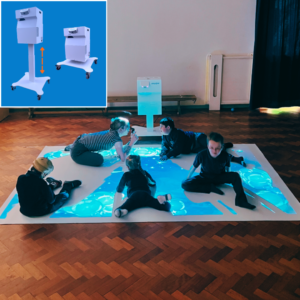
Mobile Interactive Provision
The Mobii can be moved between different areas of the school, projecting onto floors and tables and allowing interactive activities to be brought to pupils where they are needed.
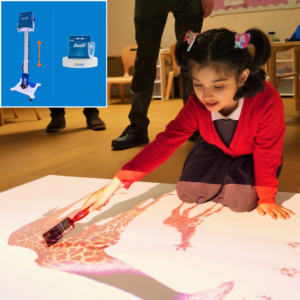
Flexible Multi-Projection
Budii Flip provides multiple projection positions, giving schools flexibility to create different interactive experiences within the same space.

Permanent Interactive Spaces
omiVista Install provides a fixed ceiling-mounted interactive floor and table solution for schools looking to establish a permanent interactive area.
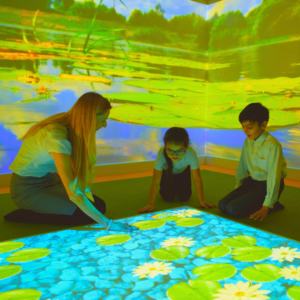
Immersive Sensory Spaces
OMi technology can also form part of wider sensory spaces combining interactive projection with visual, movement and sensory experiences.
Planning your school’s inclusion strategy
Schools receiving the Inclusive Mainstream Fund are required to develop and publish an inclusion strategy.
The strategy should identify the commonly occurring and predictable needs within the school’s cohort, the barriers to learning experienced by pupils with additional needs, how the school already invests in inclusion and its plans for further investment.
For the 2026–27 academic year, schools must publish their inclusion strategy statement by 31 December 2026. The DfE states that these strategies should be available to parents and can be considered by Ofsted inspectors when evaluating inclusion.
This gives schools an opportunity to consider not simply individual resources, but how their environments, teaching, interventions and wider provision work together to remove barriers and enable greater participation.
Experience interactive sensory technology in your school
If you’re reviewing your school’s inclusive provision, OMi offers FREE, no-obligation on-site demonstrations.
Our team can visit your school and demonstrate interactive sensory technology in your own environment, giving staff and pupils an opportunity to experience the technology first-hand and explore how it could complement your existing approach to inclusion.
Book your FREE on-site demonstration
Speak to our team to arrange a visit to your school.
Call: 01442 215 555
Or contact us to arrange your demonstration.

Important information
The Inclusive Mainstream Fund must be used in accordance with the Department for Education’s conditions of grant. Schools are responsible for determining how their allocation is used based on the needs of their pupils and must ensure expenditure aligns with the DfE’s principles for inclusive practice.
For full eligibility, permitted expenditure and accountability requirements, schools should refer to the official Department for Education guidance.

